


8 September 2026, Kochi
The familiar blue-green Chromis, long traded worldwide as Chromis viridis, has turned out to be two distinct species. Scientists from ICAR-National Bureau of Fish Genetic Resources, Lucknow have discovered and described a new species, Chromis veneta sp. nov., from Indian Ocean. The discovery emerged from marine biodiversity conservation research in Lakshadweep, where blue-green damselfishes have traditionally been used as live bait for yellowfin tuna fishing.
As part of efforts to develop sustainable alternatives, ICAR-NBFGR scientists initiated captive-breeding research and succeeded with experimental successes and the findings published in international journal, Aquaculture in 2024. Continuing this work, researchers combined genetic and morphological analyses and found that, Lakshadweep blue-green chromis comprises two species.
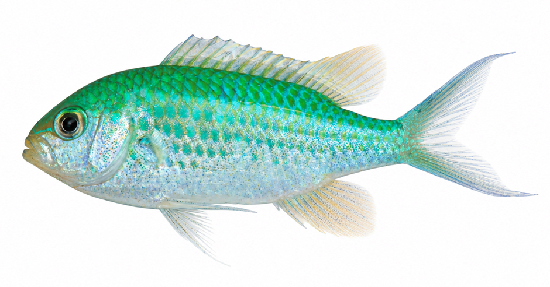
Although C. veneta closely resembles C. viridis in its blue-green colour, however, differs in body shape, pigmentation, fin margins, caudal-fin structure, dentition, gill-raker counts and sagittal otolith morphology. The interesting finding is C. veneta is not restricted to India, it has also been distributed in Indonesia, Madagascar, Fiji and Lizard Island in Australia's Great Barrier Reef, suggesting a potentially much wider distribution yet to be documented. Based on our study, in India, it is confirmed from Lakshadweep and Gulf of Mannar, and the findings appeared in one of leading international journals, Frontiers in Marine Science.
The discovery has important implications for the global marine ornamental fish trade, as C. veneta may have been collected and sold for decades under the name C. viridis. It also highlights the importance of accurate species identification for sustainable aquarium trade, captive breeding and reef-fish conservation.
According to Dr Kajal Chakraborty, Director, ICAR-NBFGR, a fish once considered a single species has now revealed a hidden chapter of reef biodiversity, potentially redefining how one of the world's most popular damselfishes is identified and traded.
(Source: ICAR-National Bureau of Fish Genetic Resources, Lucknow)





Like on Facebook
Subscribe on Youtube
Follow on X X
Like on instagram