


17 March 2026, New Delhi
The National Disaster Management Authority organized a national-level launch-cum-inception workshop for the project ‘Catalytic Assistance to the Twelve Most Drought-Prone States’ under the National Disaster Mitigation Fund at the NASC Complex, New Delhi. The programme was jointly conducted in collaboration with the National Rainfed Area Authority (NRAA) and the International Crops Research Institute for the Semi-Arid Tropics (ICRISAT).
The project aims to strengthen drought mitigation efforts and promote resilient landscapes across twelve climate-vulnerable states Andhra Pradesh, Bihar, Jharkhand, Karnataka, Madhya Pradesh, Odisha, Maharashtra, Rajasthan, Tamil Nadu, Telangana, Gujarat, and Uttar Pradesh. It focuses on enhancing preparedness, climate adaptation, and sustainable natural resource management, particularly for small and marginal farmers in drought-prone regions.
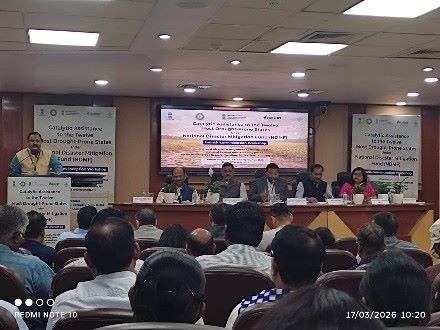
In his inaugural address, Dr Krishna S. Vatsa, Member and Head, Department, NDMA and Chairman, Technical Advisory Committee, elaborated on the origin and significance of the project. Shri S. Rakesh Kumar, Joint Secretary, NDMA, outlined the objectives of the workshop.
Remarks on the project were delivered by Dr V. K. Singh, Director, ICAR–CRIDA, Hyderabad, and Dr Himanshu Pathak, Director General, ICRISAT, Hyderabad.
Dr Susama Sudhishri, Expert, NRAA, presented the monitoring and evaluation framework, including data collection methodologies and tools. Dr Shalander Kumar, ICRISAT, Hyderabad, detailed the implementation framework, including guidelines, the Project Management Unit (PMU), dashboard, and the roles and responsibilities of technical institutions.
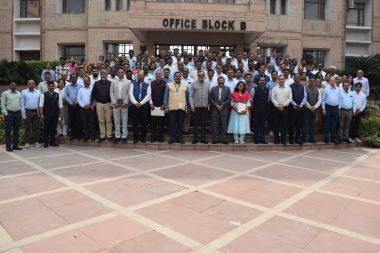
The workshop was attended by Dr Alok Sikka, Country Representative–India, International Water Management Institute (IWMI), along with state and district nodal officers and senior officials from participating states. The event provided a platform for deliberations on coordinated strategies for effective implementation of the project across drought-prone regions of the country.
(Source: ICAR-Central Research Institute for Dryland Agriculture, Hyderabad)





Like on Facebook
Subscribe on Youtube
Follow on X X
Like on instagram