


A low-cost mushroom enterprise is helping farmers turn agricultural residues into an additional source of income, employment and rural entrepreneurship
For farmers in the remote Noksosang village of Longleng district, Nagaland, traditional jhum cultivation has long been the mainstay of their livelihoods. However, limited opportunities for supplementary farm income have remained a persistent challenge. In this setting, scientific oyster mushroom cultivation has emerged as a promising low-investment enterprise, offering rural households an opportunity to diversify their livelihoods while making productive use of locally available agricultural residues.
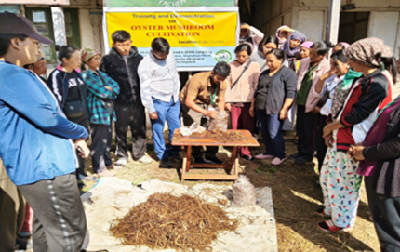
Recognising the need for income diversification and the potential of agricultural biowastes, ICAR–Krishi Vigyan Kendra (KVK), Longleng initiated efforts to promote scientific oyster mushroom cultivation among farmers and rural youth. Through skill-development training, practical demonstrations, input support and continuous technical guidance, the KVK has helped farmers acquire the skills required to convert locally available paddy straw and other agricultural residues into a nutritious and marketable food product.
One such farmer is Shri Ongthan Phom, around 38 years old, who was once largely dependent on traditional jhum cultivation with limited avenues for additional income.
From Traditional Farming to Mushroom Entrepreneurship
Encouraged by Shri Shubhendu Kumar Behera, Scientist, ICAR-KVK Longleng, Shri Phom participated in a series of skill-development and capacity-building programmes organised by the KVK on scientific oyster mushroom cultivation.
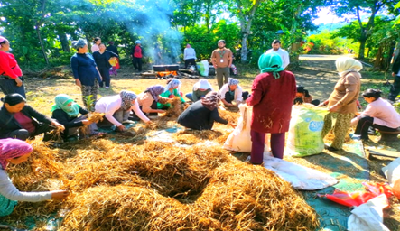
The training provided him with practical knowledge of the complete production cycle, including substrate preparation, spawn inoculation, disease management, harvesting, post-harvest handling and scientific processing for improved marketing. Particular emphasis was placed on the efficient utilisation of locally available paddy straw, enabling the farmer to use a resource that would otherwise have been discarded.
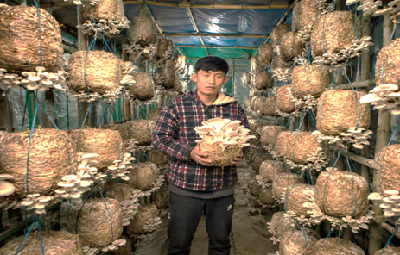
With the technical support of the KVK, Shri Phom established a low-cost mushroom production unit using locally sourced bamboo, polythene sheets, paddy straw and other agricultural residues. The mushroom-growing shed was constructed without any formal construction expenditure, keeping the initial investment and overhead costs low.
What began as a modest intervention gradually developed into a viable livelihood enterprise.
A Small Enterprise with Tangible Returns
Shri Phom currently maintains approximately 300–320 mushroom production bags per cycle and undertakes three production cycles in a season, resulting in around 900–960 bags per season.
The enterprise produces approximately 256–260 kg of fresh oyster mushrooms per cycle, translating into around 768–780 kg per season. The mushrooms are marketed in nearby villages, local markets and Longleng town, where they fetch an average price of ₹180–250 per kg.
Based on these production and market conditions, Shri Phom is estimated to generate a gross return of ₹64,000–70,000 per cycle, with a net profit of approximately ₹45,000–50,000, against an initial outlay of only ₹12,000–15,000 per cycle.
With three production cycles in a season, the enterprise generates an estimated gross return of ₹1.92–2.00 lakh, with a reported net profit of approximately ₹1.49–1.50 lakh per season and a Benefit ratio of 4.44:1.
For a farmer previously dependent primarily on traditional jhum cultivation, the enterprise has created a significant additional avenue for farm income.
Turning Agricultural Waste into Wealth
The appeal of oyster mushroom cultivation in Longleng extends beyond its economic returns. The enterprise requires limited space, relatively low investment and locally available agricultural residues, making it compatible with the existing farming systems of rural households.
Paddy straw and other agricultural residues that might otherwise be left unused are converted into a productive input for mushroom cultivation. This not only generates an additional source of income but also promotes resource recycling and more efficient utilisation of farm biomass.
The enterprise can also be integrated with existing crop and livestock activities at the household level. Family members can participate in different stages of production, creating opportunities for women and rural youth to engage in small-scale entrepreneurship and employment.
One Farmer, Many New Possibilities
The success of Shri Phom’s enterprise has attracted growing interest among farmers and rural youth in Noksosang and neighbouring areas. His experience has demonstrated that mushroom cultivation can be adapted to local agro-climatic conditions and undertaken as a supplementary livelihood activity without requiring large investments or extensive land.
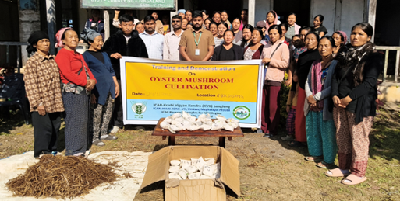
Shri Phom is now recognised as a resource farmer in scientific mushroom farming, and his farm serves as a regular demonstration site. Farmers visiting the unit can observe different stages of mushroom production and gain practical understanding of the techniques involved.
He also participates in farmer-to-farmer knowledge-sharing programmes facilitated by the KVK and NGOs, allowing his experience to reach a wider farming community.
The mushroom entrepreneurship initiative has so far reached 11 women Self-Help Groups (SHGs) and 9 unemployed rural youth from Noksosang, Yangching and Pongo villages of Longleng district. The growing interest reflects the potential of a simple, locally adaptable enterprise to generate a wider multiplier effect within rural communities.
A Model for Livelihood Diversification
The experience of Shri Ongthan Phom illustrates how targeted technical guidance, locally available resources and farmer initiative can combine to create viable livelihood opportunities in economically and geographically challenging regions.
For traditional jhum farmers, oyster mushroom cultivation offers an additional enterprise that can complement existing agricultural activities rather than replace them. Its relatively low investment requirement, limited space requirement and scope for family labour participation make it particularly relevant for rural households, women and youth.
The use of paddy straw and other agricultural residues further strengthens the sustainability of the enterprise by promoting farm-waste recycling and circular use of local resources.
Looking Ahead
With increasing farmer interest, availability of local resources and continued technical support from ICAR-KVK Longleng, oyster mushroom cultivation holds considerable potential for expansion across the district.
The experience of Shri Phom has shown that a small, low-cost enterprise can create tangible opportunities for income diversification, rural entrepreneurship, employment generation and resource recycling. More importantly, his journey has encouraged other farmers and rural youth to explore mushroom cultivation as a practical livelihood option.
From depending largely on traditional jhum cultivation to becoming a resource farmer and mushroom entrepreneur, Shri Ongthan Phom’s journey demonstrates the power of knowledge, innovation and appropriate technology in creating new possibilities for rural livelihoods.
In Longleng, a simple mushroom shed built from bamboo and locally available materials has become more than a production unit it has emerged as a demonstration of how agricultural residues can be transformed into income, skills and opportunity.
(Source: ICAR–Krishi Vigyan Kendra, Longleng)





Like on Facebook
Subscribe on Youtube
Follow on X X
Like on instagram