


7 July 2026, Dirang, Arunachl Pradesh
In a significant step towards strengthening technology-driven yak husbandry in the Indian Himalayan Region, a team of scientists from the ICAR–National Research Centre on Yak, Dirang and Assam Don Bosco University, Guwahati, has developed an Internet of Things (IoT)-based smart system for yak health monitoring, stress prediction and geo-fencing. The innovative technology is designed to address the major challenges of yak management in remote, high-altitude regions, where continuous physical monitoring of animals is often difficult. The system is also expected to help address issues related to livestock movement near international border areas.
Congratulating the team of inventors, Dr Mihir Sarkar, Director, ICAR–National Research Centre on Yak, Dirang, said, "Yaks are a vital livelihood resource for communities living in the high-altitude Himalayan region. However, yak farmers often face challenges in tracking animal movement, detecting health problems at an early stage, and managing herds spread across vast grazing landscapes. The newly developed technology can assist farmers by providing timely information on animal health, stress levels, and movement patterns, enabling better decision-making in day-to-day herd management and ensuring timely veterinary intervention whenever required."
Dr. Sarkar further emphasized that developing field-oriented, need-based technology is essential for supporting yak-rearing communities and strengthening scientific interventions in the Indian Himalayan Region, despite the unique challenges associated with the region.
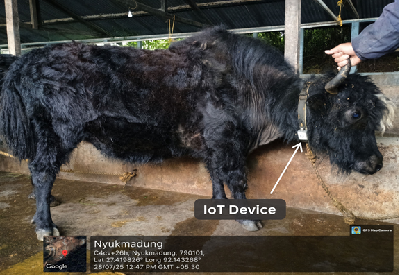
The system is expected to be particularly beneficial for yak farmers practicing traditional free-ranging grazing systems, where animals often roam in distant and difficult-to-access locations. By enabling real-time health monitoring and geo-fencing, the technology can help reduce the risk of animals straying away, facilitate the early detection of stress or illness, and minimize the need for frequent manual tracking under harsh climatic conditions. This will not only save farmers time and effort but also improve animal safety, productivity and welfare.
The technology was developed by a multidisciplinary team comprising Dr. Mokhtar Hussain, Senior Scientist (AR&G); Dr. Vijay Paul, Principal Scientist (VPY); Dr. Dinamani Medhi, Principal Scientist (AN); and Dr. Mihir Sarkar, Director, ICAR–National Research Centre on Yak, Dirang.
The team also included Dr. Rupesh Mandal, Assistant Professor; Dr. Nupur Choudhury, Assistant Professor; Dr. Gitu Das, Assistant Professor and Dr. Jyoti Kumar Barman, Assistant Professor, Assam Don Bosco University, Guwahati.
The Centre acknowledged the valuable collaborative contribution of Assam Don Bosco University, particularly in the areas of Artificial Intelligence (AI), Internet of Things (IoT), embedded systems and technology development. The successful development of this smart yak health monitoring and geo-fencing system marks an important milestone in advancing precision livestock technologies and demonstrates the commitment of ICAR–NRC on Yak to promoting innovation, precision livestock management, and sustainable yak husbandry in the Indian Himalayan Region.
(Source: ICAR-National Research Centre on Yak, Dirang, Arunachal Pradesh)




Like on Facebook
Subscribe on Youtube
Follow on X X
Like on instagram