


17 June 2026, Motihari, Bihar
As part of the nationwide Khet Bachao Abhiyan–2026 and the Farmer FIRST Programme, ICAR–Mahatma Gandhi Integrated Farming Research Institute, Motihari organized a farmer awareness-cum-training programme on Integrated Farming Systems (IFS), soil health management, balanced fertilizer use, and summer mungbean cultivation for farmers from Balbhadarpur, Ujhilpur, Narha, and Hasanpur villages of Tetaria Block, East Champaran district, Bihar.
The Farmer FIRST (Farm, Innovations, Resources, Science and Technology) Programme of ICAR aims to strengthen farmer-scientist partnerships and place farmers at the center of technology development, validation, and adoption. The programme focuses on improving farm productivity, profitability, resilience, and sustainability through integrated resource management and climate-smart agricultural practices.
Addressing the gathering, Dr Raghavendra Singh, Director, ICAR-MGIFRI, highlighted the importance of Integrated Farming Systems (IFS) for enhancing farm income and resilience. He encouraged farmers to diversify their enterprises through fish-based farming, goat rearing, backyard poultry, and crop-based interventions. He also emphasized the adoption of Resource Conserving Technologies such as laser land levelling, efficient water management (“Khet ka Pani Khet Mein”), residue recycling, and soil-test-based nutrient management for sustainable agricultural development. During the programme, farmers actively discussed field-level challenges and opportunities for developing location-specific IFS models suited to the waterlogged and flood-prone conditions of East Champaran.
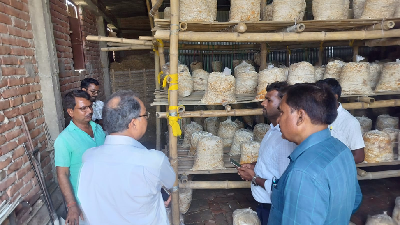
Participants were briefed on the objectives and implementation strategy of the Farmer FIRST Programme and the role of the Khet Bachao Abhiyan in promoting soil health conservation and balanced fertilizer use. The technical session emphasized crop diversification, crop planning, efficient year-round resource utilization, and adherence to a crop calendar for timely sowing, efficient input use, higher cropping intensity, and improved profitability.
The role of summer mungbean and Sesbania (Dhaincha) in enhancing soil fertility through biological nitrogen fixation was highlighted. Summer mungbean can fix about 25–30 kg N ha⁻¹, equivalent to 55–65 kg urea ha⁻¹ (1.2–1.5 bags), while Sesbania green manuring can contribute 50–60 kg N ha⁻¹, equivalent to 110–130 kg urea ha⁻¹ (2.5–3 bags). These legumes improve soil organic matter and reduce fertilizer requirements for succeeding crops.
A demonstration on mungbean root nodulation explained the role of nitrogen-fixing nodules in enriching soil fertility. Farmers described the nodules as a “natural urea factory in the field” due to their contribution to reducing fertilizer costs and improving soil health.
The importance of crop residue retention and recycling was also emphasized, as residues improve soil organic carbon, conserve moisture, support beneficial microorganisms, and reduce nutrient losses. Farmers were advised to avoid residue burning, which causes nutrient depletion, environmental pollution, and soil health deterioration.
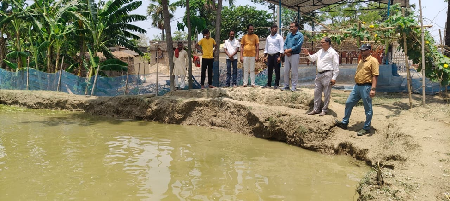
The campaign further promoted judicious fertilizer use and reduced dependence on chemical inputs. Soil-test-based nutrient management was highlighted as a means to reduce unnecessary fertilizer expenditure while improving productivity and profitability. The role of biofertilizers and eco-friendly nutrient management practices in enhancing soil biological health and nutrient-use efficiency was also emphasized.
The ICAR-MGIFRI team reviewed the progress of Farmer FIRST Programme activities, interacted with both adopted and non-adopted farmers, and collected feedback to strengthen future interventions and refine village-level implementation strategies.
Scientists also demonstrated sustainable crop residue management practices and promoted the principles of natural farming and integrated nutrient management for long-term soil health restoration and climate-resilient agriculture.
A total of 54 participants, including 38 male farmers and 16 female farmers, participated in the programme and actively interacted with scientists on sustainable farming solutions.
(Source: ICAR–Mahatma Gandhi Integrated Farming Research Institute, Motihari, Bihar)





Like on Facebook
Subscribe on Youtube
Follow on X X
Like on instagram