


18 August 2026, Bharatpur
ICAR–Indian Institute of Rapeseed-Mustard Research, Bharatpur, hosted the 33rd Annual Group Meeting (AGM) of the All India Coordinated Research Project (AICRP) on Rapeseed-Mustard on 17–18 August 2026. The two-day national meeting brought together more than 180 scientists, experts, policymakers, industry representatives and progressive farmers from across the country to deliberate on strategies for enhancing rapeseed-mustard productivity, quality and climate resilience.
Addressing the gathering as the Chief Guest, Dr M. L. Jat, Secretary, DARE and Director General, ICAR, emphasized that enhancing rapeseed-mustard productivity is crucial for reducing India’s dependence on edible oil imports and advancing the vision of Atmanirbhar Bharat. He called for the development of next-generation mustard varieties with higher yield potential, superior oil quality, resistance to major diseases such as Orobanche (broomrape) and stem rot, and greater resilience to rising temperatures and climate variability. He also stressed the importance of pre-breeding, integrated cropping systems and effective technology dissemination to farmers for sustainable productivity enhancement.
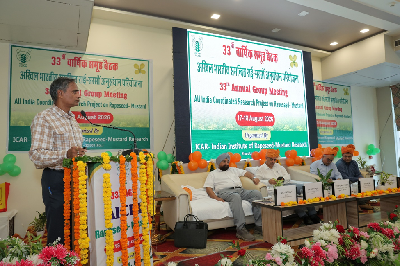
Dr D. K. Yadava, Deputy Director General (Crop Science), ICAR, highlighted the transformative role of modern biotechnology and advanced breeding approaches in addressing emerging challenges in mustard production. He emphasized the development of next-generation varieties combining higher disease resistance with quality traits such as low erucic acid and low glucosinolate content. He noted that breaking the prevailing yield stagnation is essential to meet the country’s growing edible oil demand and strengthen self-reliance. He called for the strategic integration of genomics, cutting-edge biotechnology, modern breeding and conventional breeding approaches to accelerate the development of high-yielding, climate-resilient, disease-resistant and farmer-preferred mustard varieties.
The plenary session was chaired by Dr Sanjeev Gupta, Vice Chancellor, CSAUA&T, Kanpur, who provided comprehensive suggestions for formulating the technical programme across research disciplines. He emphasized addressing emerging challenges, strengthening interdisciplinary research and making the AICRP-RM programme more focused, demand-driven and outcome-oriented to support sustainable growth of the rapeseed-mustard sector and advance India’s journey towards edible oil self-reliance.
Earlier, Dr V. V. Singh, Director, ICAR-IIRMR, welcomed the distinguished guests and delegates participating physically and virtually and presented the progress report of the AICRP along with the action taken on the recommendations of the previous meeting.
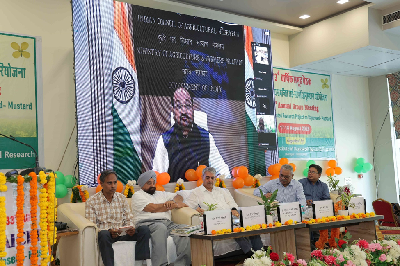
Former National Professor Dr S. S. Banga highlighted the potential of gene-editing and genomic technologies to transform mustard improvement by enhancing productivity, quality and resilience.
Dr S. K. Jha, Assistant Director General (Oilseeds & Pulses), ICAR, outlined the priorities of coordinated research programmes on mustard and other oilseeds, while Dr. P. R. Choudhary, Assistant Director General (Seeds), ICAR, underscored the importance of quality seed production and timely dissemination of improved varieties for realizing their genetic potential at farmers’ fields.
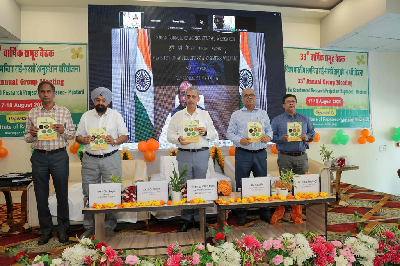
During the AGM, six publications were released, including the Annual Report of AICRP-RM 2025–26; Rapeseed-Mustard Production Technologies for Uttar Pradesh; Directory of AICRP-RM Research Workers; AICRP-RM Achievements; Speed Breeding, published by ICAR-IIRMR, and the Annual Progress Report of the Mega Project, published by ZRAS, Shillongani, Assam.
The meeting also witnessed the signing of two strategic agreements aimed at strengthening public-private collaboration in agricultural innovation. ICAR-IIRMR entered into an agreement with Kamadgiri Crop Science Pvt. Ltd. for collaborative research at its state-of-the-art Speed Breeding Facility. Another agreement was signed with Mahalakshmi Bioscience Pvt. Ltd., Gujarat, for licensing the institute’s promising mustard variety NRCHB-506. The partnerships are expected to accelerate technology commercialization and facilitate wider dissemination of improved technologies and varieties among farmers.
During the Varietal Identification Committee meeting, four varieties were identified for release: RH 2299-63 (timely sown irrigated, Zone-I), SKM 2104 (timely sown irrigated, Zone-I), HRH 191290 (hybrid, Zone-II) and BPM 181 (late-sown irrigated, Zone-III).
The AGM featured intensive scientific deliberations on improved varieties and hybrids, productivity enhancement, quality improvement, pest and disease management, climate adaptation, biotechnology applications and future research priorities. Progressive farmers also participated in the interactive session and shared their experiences and interacted with scientists.
The recommendations emerging from the meeting are expected to provide a strategic roadmap for strengthening research, innovation and technology delivery in the rapeseed-mustard sector and contribute to India’s goal of edible oil self-reliance.
(Source: ICAR–Indian Institute of Rapeseed-Mustard Research, Bharatpur)





Like on Facebook
Subscribe on Youtube
Follow on X X
Like on instagram