


Nestled in the Andaman Sea between Teressa Island and Battimalv Island, Chowra Island in the Nancowry Division of the Nicobar district is one of the most remote inhabited islands of the Andaman and Nicobar archipelago. While its isolation has preserved its unique identity, it has also posed significant challenges to infrastructure development, limiting access to transportation, markets, communication, and essential public services.
Among the island's most pressing challenges is water security.
Unlike many other regions, Chowra Island has no dependable freshwater source. The island's hydrogeological conditions render most of its shallow groundwater saline and unsuitable for drinking or irrigation. As a result, the island's residents depend almost entirely on rainfall to meet their domestic, agricultural, and livestock water requirements. Although households traditionally harvest rainwater through rooftop collection systems and store it in plastic or steel tanks, the limited storage capacity often falls short during the dry season. Constructing larger rainwater harvesting systems has remained difficult due to the island's remoteness, inadequate infrastructure, and the logistical challenges of transporting construction materials and heavy machinery.
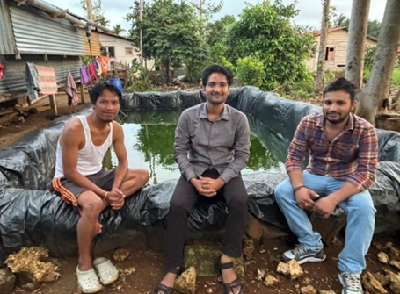
Recognizing the urgent need for a sustainable and locally adaptable solution, ICAR–Krishi Vigyan Kendra (KVK), CIARI, Nicobar, in collaboration with the Tribal Council of Chowra, introduced a demonstration project aimed at strengthening water security through low-cost rainwater harvesting structures.
Under the initiative, ten rainwater harvesting ponds, each measuring 7 m × 5 m × 1.5 m, were constructed to capture and store rainwater for agricultural and livestock use. To minimize seepage losses and maximize storage efficiency, each pond was lined with High-Density Polyethylene (HDPE) sheets, creating a durable and impermeable barrier.
Implementing the project, however, required overcoming extraordinary challenges. Due to the island's remoteness, transporting heavy earthmoving equipment was not feasible. The task became even more demanding because of the hard coral rock deposits beneath the soil. Undeterred, the excavation was carried out manually with the support of portable drilling machines, demonstrating that innovative, low-cost technologies can succeed even under the most challenging field conditions. The resulting model proved to be durable, economical, and well suited to the island's unique edaphic and climatic conditions.
The impact of the intervention was immediate and encouraging.
The rainwater harvesting ponds significantly improved the availability of freshwater for irrigation, livestock, and other agricultural activities. Beyond their intended purpose, the stored water also became an important source for domestic use. To ensure water quality and protect it from contamination, the ponds were secured through appropriate fencing and covering measures.
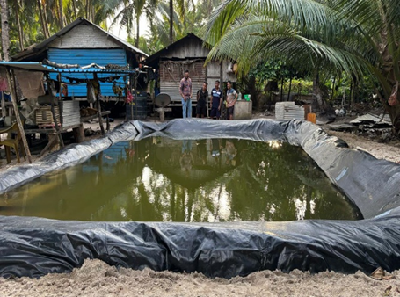
The initiative received widespread appreciation from the local community for its affordability, practicality, and ease of replication. Encouraged by the visible benefits, several farmers expressed their willingness to construct similar ponds on their own land using locally available labour. The technology's simple design, low construction cost, and minimal dependence on external resources have made it an ideal solution for wider adoption across the island.
The success of the demonstration has also inspired community leadership. Impressed by its effectiveness, the Tribal Council of Chowra formally approached ICAR-KVK CIARI, Nicobar, seeking continued technical guidance and support for procuring HDPE lining materials to replicate the model across the island.
What began as a demonstration of low-cost rainwater harvesting has now emerged as a practical pathway towards long-term water resilience for one of India's most remote island communities. By combining scientific innovation with community participation and locally appropriate technologies, ICAR-KVK CIARI, Nicobar has showcased how sustainable interventions can overcome geographical constraints, strengthen climate resilience, and improve the livelihoods of island communities.
(Source: ICAR-Central Island Agricultural Research Institute, Sri Vijaya Puram)





Like on Facebook
Subscribe on Youtube
Follow on X X
Like on instagram