


Lakshadweep Union Territory stands today as one of India’s most remarkable success stories in organic agriculture. Nestled in the Arabian Sea, these fragile coral islands have demonstrated how traditional wisdom, community stewardship, and institutional innovation can together create a globally relevant model of sustainable farming.
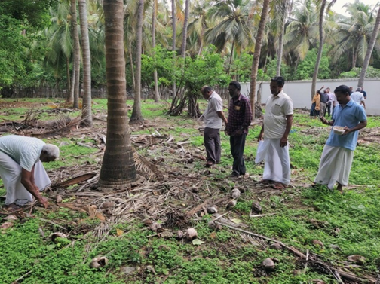
Long before organic farming became a national priority, the people of Lakshadweep had embraced it as a way of life. Since 2005, island communities have voluntarily prohibited the use of chemical fertilisers and pesticides to safeguard their limited land resources, lagoons, and coral reefs. Agriculture evolved as an eco-friendly, low-input, subsistence system rooted in coconut-based farming, backyard vegetable cultivation, and complete biomass recycling. However, despite being organic by default, farmers lacked formal certification, which limited market access and price realisation. Recognising this gap, the Union Territory of Lakshadweep Administration, in partnership with Krishi Vigyan Kendra, Lakshadweep, initiated a structured effort to formally validate the organic identity of the islands.
Initial certification efforts began in 2009 under NPOP/NOP standards through APEDA using third-party certification. While scientifically robust, this approach proved expensive and logistically challenging for small island farmers. A decisive shift occurred in 2019–20 with the adoption of the Participatory Guarantee System (PGS–India) under the Paramparagat Krishi Vikas Yojana. This community-based certification model was ideally suited to Lakshadweep’s smallholder-dominated, trust-based farming systems.
Under the PGS approach, entire islands were treated as single organic units, and farmers were organised into PGS groups. Krishi Vigyan Kendra, Lakshadweep provided technical guidance, documentation support, training, and digital registration, while the Union Territory Administration ensured policy support and institutional convergence, creating a strong and inclusive certification framework.
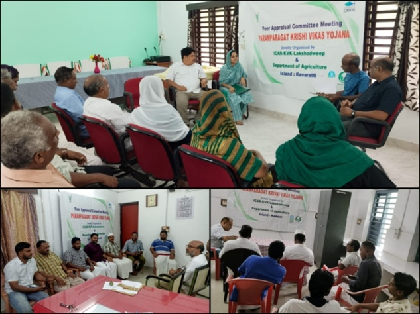
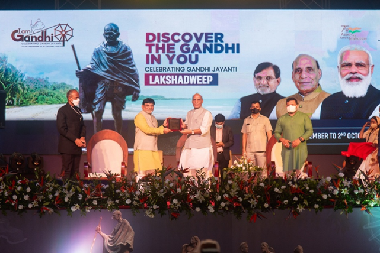
By 2024, a total of 8,126 farmers across all inhabited islands were registered on the PGS portal, and the entire cultivable area of Lakshadweep was brought under Large Area Certification. This achievement positioned Lakshadweep as one of the largest contiguous certified organic territories in India. The milestone received national recognition when the Hon’ble Union Minister for Defence formally released the Organic Certificate for Lakshadweep Islands, symbolising the national acknowledgement of this pioneering effort.
Sustaining the momentum of organic certification was managed through strong institutional coordination. When the Large Area Certification expired in November 2023, the Union Territory Administration promptly convened a State Level Executive Committee meeting. Krishi Vigyan Kendra, Lakshadweep was entrusted with farmer verification, compliance documentation, and renewal coordination, ensuring seamless continuity and reinforcing local ownership of the organic certification process.
The declaration of Lakshadweep as an organic territory has delivered tangible benefits across ecosystems and livelihoods. Farmers gained enhanced credibility and identity for island produce, improved access to premium organic markets, and strengthened farmer institutions through collective action. Environmental gains included protection of fragile coral reefs and lagoon ecosystems, prevention of chemical contamination, and improvements in soil health and biodiversity conservation. From a governance perspective, the initiative strengthened convergence between the Union Territory Administration, KVK, and farming communities, offering a replicable model for islands and ecologically sensitive regions while aligning with national goals of climate-resilient and sustainable agriculture.
Building on this success, Lakshadweep is now poised to strengthen organic value chains and branding, ensure the availability of quality seeds and organic inputs, develop island-specific organic standards and traceability systems, and integrate organic farming with eco-tourism and blue economy initiatives.
Lakshadweep’s journey from traditional organic practices to formal Large Area Certification demonstrates that sustainability is most effective when rooted in community values and supported by responsive institutions and enabling policies. This success story offers a compelling blueprint for other island ecosystems and fragile regions across India, proving that ecological conservation and farmer prosperity can advance together.
(Source: ICAR-Krishi Vigyan Kendra, Lakshadweep)





फेसबुक पर लाइक करें
यूट्यूब पर सदस्यता लें
X पर फॉलो करना X
इंस्टाग्राम पर लाइक करें