


29 June 2026, Motihari, Bihar
As part of the nationwide Khet Bachao Abhiyan–2026, the ICAR–Mahatma Gandhi Integrated Farming Research Institute, Motihari, organized a hands-on training and exposure visit for farmers from Mehsi, Chakia, and Piprakothi blocks of East Champaran district, Bihar. The programme showcased the role of Dhaincha (Sesbania) green manuring and Integrated Farming Systems (IFS) in restoring soil health, reducing dependence on chemical fertilizers, and strengthening climate resilience in rice-based farming systems.
The programme featured field demonstrations of Dhaincha green manuring plots, Integrated Farming System models, vermicomposting units, and resource recycling technologies developed at the institute. Through practical demonstrations, farmers were introduced to biological and nature-based approaches that complement chemical fertilizers while enhancing long-term soil productivity and sustainability.
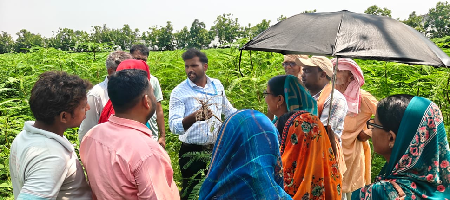
Technical sessions highlighted the growing challenges of declining soil organic carbon, nutrient imbalances, and excessive dependence on chemical fertilizers, emphasizing the need to restore soil biological health through green manuring, crop diversification, integrated nutrient management, and organic nutrient recycling.
Farmers were informed that a well-grown Dhaincha crop can biologically fix approximately 50–60 kg nitrogen per hectare, equivalent to nearly 110–130 kg of urea per hectare (about 2.5–3 bags of urea). It was explained that in rice cultivation, Dhaincha can supply nearly 25–40 percent of the crop's nitrogen requirement, significantly reducing fertilizer costs while improving soil organic matter, soil structure, microbial activity, and nutrient-use efficiency.
Live demonstrations illustrated the incorporation of Dhaincha into the soil 40–45 days after sowing, enabling the green biomass to decompose into a valuable source of nutrients and organic carbon. Farmers actively interacted with experts on seed rate, sowing methods, biomass incorporation, and the integration of green manuring into rice-based cropping systems.
The programme also emphasized the importance of farmyard manure, compost, vermicompost, crop residue recycling, and biofertilizers in maintaining soil fertility. Participants were encouraged to adopt integrated nutrient management practices to replenish organic matter, improve beneficial microbial populations, and sustain productivity in intensive rice–wheat, maize, and sugarcane production systems.
As part of the exposure visit, farmers observed various Integrated Farming System models, including crop-livestock integration, horticulture-based enterprises, resource recycling technologies, and climate-resilient farming practices. The demonstrations highlighted how diversified farming systems can improve resource-use efficiency, stabilize farm income, reduce production risks, and enhance resilience to floods, droughts, and market fluctuations.
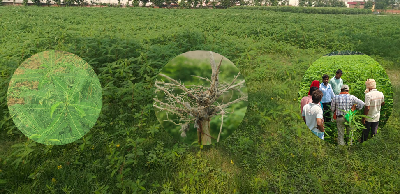
During the interactive session, farmers raised concerns over rising fertilizer prices and declining soil fertility. Experts demonstrated how green manuring, pulse-based crop diversification, crop residue recycling, and integrated nutrient management can reduce external input dependence while maintaining crop productivity. Many participants expressed interest in adopting Dhaincha before rice transplanting and sought support for the availability of quality seed to promote wider adoption in their villages. Women farmers actively participated in the discussions and appreciated the practical demonstrations on low-cost soil health improvement technologies.
The programme concluded with a strong message that healthy soils are the foundation of profitable and sustainable agriculture. Farmers were encouraged to adopt soil test-based nutrient management, replace a portion of chemical nitrogen with biological sources, and strengthen organic matter recycling to ensure long-term soil fertility and environmental sustainability.
A total of 49 farmers, including 18 men and 31 women, participated in the programme and actively interacted with experts on issues related to soil degradation, nutrient management, rising fertilizer costs, and climate-resilient agriculture.
Through field-based demonstrations and farmer-scientist interactions under the Khet Bachao Abhiyan, ICAR-MGIFRI continues to promote soil health-centred, nature-based agricultural practices that support resilient, productive, and sustainable farming systems.
(Source: ICAR–Mahatma Gandhi Integrated Farming Research Institute, Motihari, Bihar)





Like on Facebook
Subscribe on Youtube
Follow on X X
Like on instagram