


28 October 2026, New Delhi
H.S.H. Hereditary Prince Alois of Liechtenstein visited the ICAR–Indian Agricultural Research Institute, New Delhi, today, to explore opportunities for strengthening bilateral cooperation in agricultural research, technological innovation and sustainable agri-food systems. The Prince was accompanied by Ms. Sabine Monauni, Deputy Prime Minister and Minister of Foreign Affairs, Environment and Culture; Mr. Martin Frick, Director, Office for Foreign Affairs; and Mr. Andreas Foser, Diplomatic Officer, Office for Foreign Affairs and the delegates of Savannah seeds.
The delegation was warmly received by Dr M. L. Jat, Secretary, DARE and Director General, ICAR; Dr D. K. Yadava, Deputy Director General, ICAR; and Dr Ch. Srinivasa Rao, Director, ICAR-IARI.
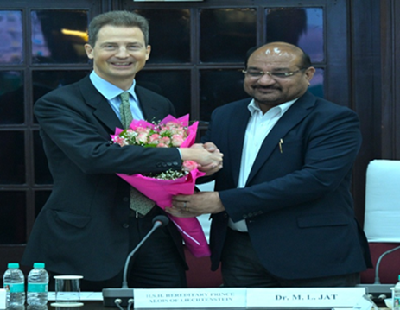
Dr M. L. Jat presented an overview of ICAR’s extensive agricultural research network and its contributions to national agricultural development and international scientific cooperation, particularly with neighboring countries and nations of the Global South. Reflecting on India’s transformation from a food-deficit to a food-surplus nation, he underscored the role of system science, enabling policies and stakeholder collaboration. He highlighted the need for integrated, systems-based approaches that connect agricultural production with value chains, nutrition, health, economics and environmental sustainability. He also emphasized the strategic role of industries and Micro, Small and Medium Enterprises in accelerating agricultural innovation, technology adoption and value addition.
Dr. D. K. Yadava showcased the contributions of ICAR’s Crop Science Division to the development and commercialization of climate-resilient, biofortified and input-efficient varieties of field and horticultural crops. He emphasized the importance of enhancing agricultural productivity while minimizing the environmental impacts.
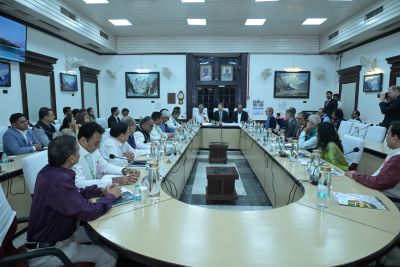
The discussions covered climate-resilient agriculture, nutritional security, advanced crop improvement and sustainable resource management. Biofortification, including wheat enriched with essential micronutrients such as zinc and iron, was highlighted as an important approach to improving nutritional outcomes. The potential of gene-editing and other advanced biotechnological tools to develop improved crop varieties with enhanced productivity and resilience was also discussed.
Dr Ch. Srinivasa Rao, highlighted ICAR-IARI’s historic contribution to India’s Green Revolution and its continuing role in strengthening agricultural productivity and nutritional security.
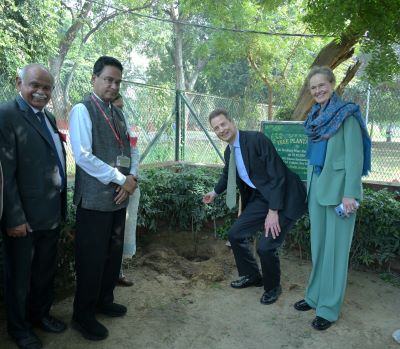
The delegation visited the Genetics Division of ICAR–IARI and interacted with scientists on the various crop varieties developed by the Division. The interaction provided an opportunity to exchange perspectives on emerging agricultural technologies and their potential contribution to future scientific cooperation. The delegation also visited the IARI Alumni Association, where members engaged with the institute’s alumni community. H.S.H. Prince Alois planted a tree in IARI Alumni complex.
Following the tree plantation, H.S.H. Prince Alois unveiled the socio-economic impact study report, “FDI, Innovation and Technology in Rice Cultivation: The Case of Savannah Seeds” at IAA office Dr. Ashok Gulati, Economist at the Indian Council for Research on International Economic Relations (ICRIER), presented the key findings of the study, highlighting the socio-economic dimensions of foreign direct investment, innovation and technology in rice cultivation.
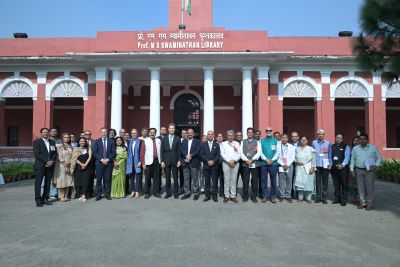
The visit highlighted the scope for strengthening scientific exchanges, exploring collaborative research and developing institutional partnerships between India and Liechtenstein. Such cooperation could facilitate knowledge sharing, and support the advancement of productive, climate-resilient and environmentally robust agri-food systems.
(Source: ICAR–Indian Agricultural Research Institute, New Delhi)





Like on Facebook
Subscribe on Youtube
Follow on X X
Like on instagram