


ICAR–Central Institute for Research on Goats, Makhdoom, has achieved a significant milestone in assisted reproduction through the successful birth of twin Barbari kids using Multiple Ovulation and Embryo Transfer (MOET), embryo collection at the single-cell zygote stage, embryo vitrification, and early-stage embryo transfer into a Sirohi surrogate goat, with minimum surgical intervention. Both embryo collection and embryo transfer were performed using laparoscopic-assisted techniques, facilitating the recovery and transfer of embryos with minimal surgical intervention.
Embryos were collected from a Barbari donor doe at the zygote stage through a laparoscopic-assisted procedure and subsequently cryopreserved at the two-cell stage using vitrification. Following thawing, the embryos continued to develop and reached the four-cell stage before being transferred into a Sirohi recipient goat through a laparoscopic-assisted embryo transfer procedure.
This resulted in the birth of two healthy Barbari kids, one male and one female, on 25 October 2026. Both kids exhibited the characteristic phenotypic features of the Barbari breed, demonstrating the successful use of a Sirohi surrogate for gestation following the transfer of cryopreserved Barbari embryos.
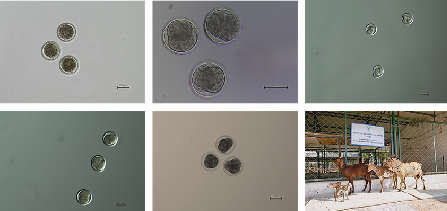
This achievement marks an important step towards the application of advanced reproductive biotechnologies for the conservation, multiplication, and propagation of elite germplasm from indigenous goat breeds. The successful cryopreservation of embryos at the two-cell stage, their continued development after thawing, and their subsequent transfer highlight the potential of vitrification as a valuable approach for preserving and utilizing genetically valuable embryos.
Furthermore, the integration of MOET, laparoscopic-assisted embryo collection, embryo vitrification, and laparoscopic-assisted early-stage embryo transfer with minimum surgical intervention offers promising opportunities for the conservation and multiplication of superior indigenous goat germplasm. This success reinforces the potential of assisted reproductive technologies to contribute to the conservation and genetic improvement of indigenous goat breeds.
(Source: ICAR–Central Institute for Research on Goats, Makhdoom)




Like on Facebook
Subscribe on Youtube
Follow on X X
Like on instagram