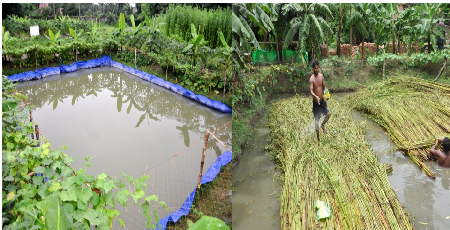
Jute is an important environment-friendly biodegradable bast fibre known as “golden fibre” mainly grown in Eastern and NE parts of the country. Traditional way of fibre extraction is mainly done by submerging the jute bundles inside water bodies which usually takes 22-25 days, many times suffers from uncertainty due to dry spell and water scarcity. Such situation adversely affects the quantity and quality of retting water in the natural water bodies. Most of the times, repeated retting in the same water leads to inferior quality of fibre and less fibre recovery. This process not only results in poor quality of fibers but also enhances cost of fibre extraction, full of drudgery and unhygienic
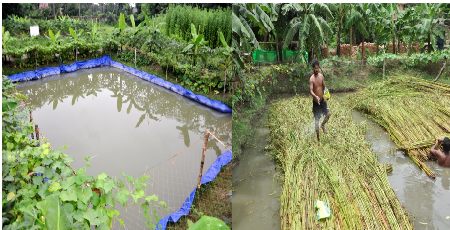
Poor-quality and inadequate quantity of retting water is a major constraint affecting jute fibre quality and market value. Farmers often transport harvested jute bundles to distant community ponds, incurring additional expenditure and depending on stagnant, contaminated water. To address these challenges, ICAR-Central Research Institute for Jute and Allied Fibres, Barrackpore has developed an innovative in-situ jute retting pond-based farming system that combines rainwater harvesting, quality retting, integrated farming and groundwater recharge.
Harvesting Rainwater for Fibre Quality, Farm Income and Climate Resilience
The technology utilizes a portion of field runoff by constructing a 50 × 40 × 5.5 ft (15.15 × 12.12 × 1.66 m) farm pond at the lowest corner of the jute/mesta field, with a 1–1.5 m wide earthen embankment. The pond can provide retting facilities for approximately 0.5 acre of jute at a time, and up to 1 acre with staggered sowing/harvesting. An inlet and outlet facilitate renewal of pond water with fresh rainwater and runoff, creating better conditions for retting microorganisms and improving fibre quality. The pond water can subsequently be utilized for supplementary irrigation, integrated farming and groundwater recharge, thereby increasing the overall utility of the structure.
Application of CRIJAF SONA, a microbial retting consortium developed by ICAR-CRIJAF, further enhances the efficiency of the system. If applied @ 14 kg/acre, retting can be completed in about 12–15 days, compared with 18–21 days under conventional retting. During the second retting cycle, the dose can be reduced by 50%, resulting in additional savings.
The use of fresh rainwater and controlled water renewal, together with CRIJAF SONA, can improve fibre quality by 1–2 grades, thereby enhancing the marketability and competitiveness of jute fibre. The technology provides direct economic benefits by eliminating the need to transport harvested jute to distant retting locations, saving approximately Rs.4,000–5,000 per acre. Improved fibre quality and efficient retting can generate an additional income of about Rs.20,000–30,000 per acre per annum.
Beyond jute production, the pond is useful for integrated farming and supplementary livelihood activities, with potential off-farm earnings of Rs.15,000–20,000 per month. Each pond can generate approximately 70–80 man-days of employment, while jute-based farming and allied activities can provide livelihood opportunities for rural youth for nearly eight months of the year. The same structure is useful for recharging ground water in rainy season.
Thus by harvesting and storing monsoon runoff, it helps to reduce water scarcity during dry spells, provides water for supplementary irrigation, supports groundwater recharge and strengthens farm resilience against drought, erratic rainfall and other extreme weather events, besides the farmers can get assured water for retting nearby to his field.
Farm-Level Innovation to National-Scale Adoption
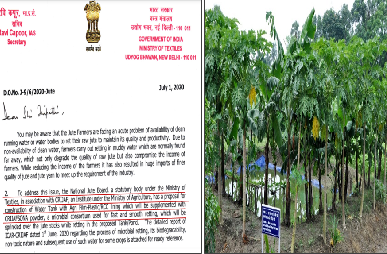
Recognizing its potential for improving jute retting and conserving rainwater, ICAR-CRIJAF prepared and submitted a proposal to the Ministry of Textiles, Government of India, for large-scale adoption of farm ponds in jute-growing areas. The technology has been considered for implementation across 372 jute-growing blocks in 63 districts covering West Bengal, Assam, Bihar, Odisha, Meghalaya, Andhra Pradesh, Tripura, Uttar Pradesh, Nagaland and Jharkhand.
(Source: ICAR-Central Research Institute for Jute and Allied Fibres, Barrackpore)