


Weeds compete with crops for essential resources such as water, nutrients, sunlight and space and reduce crop yields and profits, if not managed properly. From several years, weed infestation has therefore been one of the major constraints to sustainable crop production in India.
A clear picture of this problem was provided in the study conducted by ICAR-Directorate of Weed Research, Jabalpur in 2018, where an average actual yield loss of about 25% accounting to economic loss of nearly US$11 billion annually was estimated in major field crops of India based on 1581 On-Farm Trials conducted during 2003–2014 at different agro-ecological regions of the country under All India Coordinated Research Project on Weed Management. The losses were particularly high in groundnut (35.8%), soybean (31.4%), greengram (30.8%), pearl millet (27.6%) and maize (25.3%). These figures highlighted how a large proportion of crop production was being lost simply because of inadequate or untimely weed control.
The situation, however, has changed considerably over the following 11 years. The recent assessment again in 2026 done by ICAR-Directorate of Weed Research, Jabalpur, based on 1622 On-Farm Trials conducted during 2014–2024 across the country estimated the average yield loss due to weeds at only 13.43%. Thus, the average yield loss declined by 11.57 percentage, representing a significant reduction compared with the 2018 estimate.
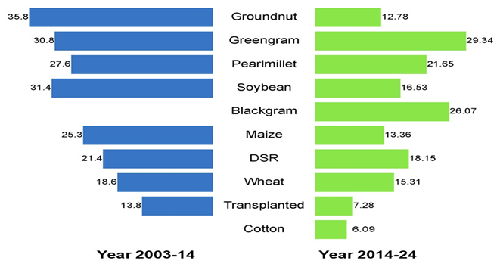
This improvement represents an important success in the management of weeds in Indian agriculture. The recent study estimated the annual economic losses due to weeds at approximately US$10.58 billion for the crops considered. This estimate is lower than the US$11 billion reported in 2018, despite the recent estimate being calculated using the revised and higher Minimum Support Prices (MSPs) of the respective crops.
This remarkable improvement did not happen because of a single technology. Over the years, farmers have gained access to a wider range of effective weed-management options, including pre-emergence and post-emergence herbicides, improved herbicide formulations, better application practices, mechanical methods and cultural practices. The increasing availability and adoption of herbicides have been particularly useful in situations where labour is scarce or manual weeding is costly and time-consuming.
Timely weed control during the critical period of crop–weed competition prevents weeds from taking away valuable water, nutrients, sunlight and space from the crop. As a result, crops are able to use available resources more efficiently and produce higher yields. Thus, the reduction in yield losses should be viewed as the combined outcome of better technology, improved knowledge level among farmers, better extension services and greater availability of weed-management technologies.
The journey from 25% average yield loss to 13.43% in approximately 11 years demonstrates that improved weed management can protect a substantial share of crop production. Moving forward, wider adoption of integrated weed management, judicious herbicide use, timely weed control, improved farmer awareness and training and capacity development of farmers can further reduce crop–weed competition, minimize yield and economic losses, and resulting to higher productivity and thus, contributing in achieving the country’s goals of Viksit Bharat@2047.
(Source: ICAR-Directorate of Weed Research, Jabalpur)





Like on Facebook
Subscribe on Youtube
Follow on X X
Like on instagram